Entering the EU with Your Pet: What Happens at the Traveller’s Point of Entry?
Last updated: 13 September 2026
You’ve got the AHC. The rabies vaccination is in date, the microchip’s been scanned and checked, the declaration’s signed. The dog is in the car, or the cat’s in her carrier, and you’re on your way to the Tunnel, the ferry, or the airport.
So what actually happens when you get there?
Most guidance on pet travel focuses on getting the certificate issued and stops there. This guide covers the part that comes after: the Traveller’s Point of Entry, the part of the certificate people often call “Section 8”, and what it means in practice if that part doesn’t get completed properly.
If you haven’t yet arranged your AHC, our complete guide to Animal Health Certificates covers the requirements and timings. This one picks up from there, at the border.

Need to know
Pets entering the EU from Great Britain under the ordinary non-commercial pet travel rules must enter through an appropriate designated Traveller’s Point of Entry and undergo the required documentary and identity checks.
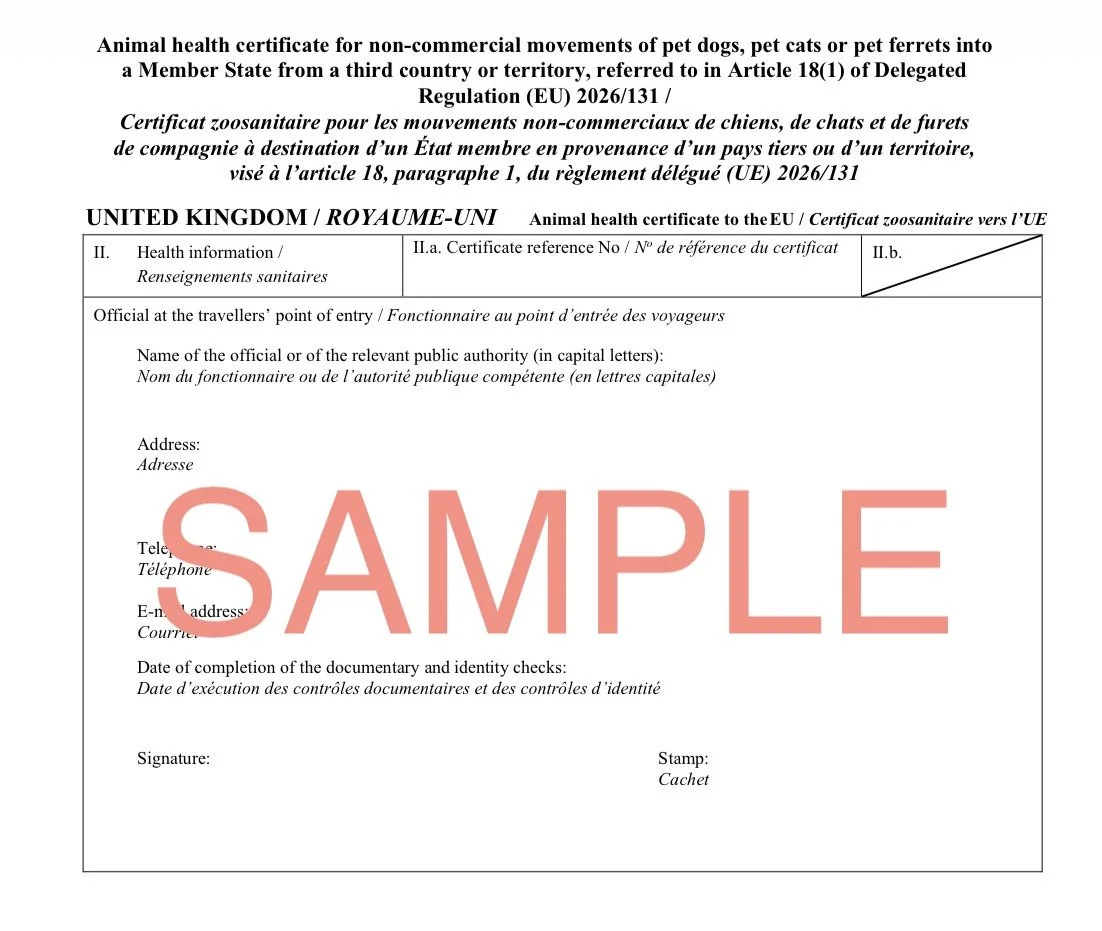
The part of the AHC often called “Section 8” is where the official at the TPE records that this check has taken place. It’s shorthand, not an official EU term.
The endorsement matters because the AHC’s onward validity within the EU, up to six months, is tied to the date of these checks. It isn’t just a formality for the record.
The practical process differs depending on whether you’re travelling by Eurotunnel, ferry, commercial flight or private aviation, so it’s worth knowing what to expect for your specific route.
Check your certificate before leaving the point of entry if you can, and deal with any missing endorsement promptly rather than assuming it doesn’t matter.
What is a Traveller’s Point of Entry for pets?
A Traveller’s Point of Entry, usually shortened to TPE, is a designated border crossing, airport or port where pets entering the EU from a non-EU country undergo documentary and identity checks. It is not any border crossing you happen to use. Each EU country publishes its own list of which crossings are set up for this, and being a busy port or a major airport does not automatically put a place on that list.
At the TPE, the check is carried out by the competent authority responsible for that point of entry. Depending on the location and local arrangements, this may involve government officials directly or authorised personnel acting on their behalf. What matters is that your pet’s documents are checked against its microchip and that everything is confirmed to be in order.
You are expected to present yourself and your pet and make contact with whoever is carrying out the check. It is not necessarily something that happens automatically when you cross a border. The responsibility sits with the traveller to make sure it happens.
What is “Section 8” on an Animal Health Certificate?
If you’ve spent any time reading pet travel forums, you’ve probably seen the term “Section 8” used, usually along the lines of “make sure you get Section 8 stamped.”
“Section 8” is not a term used in EU legislation. It’s shorthand that has grown among vets and travellers as a quick way to refer to the part of the AHC where the official at the TPE records that the check has taken place.
The AHC template has changed as the rules have evolved through 2026. Our guide to the 2026 AHC changes covers what’s different. The exact layout and numbering can depend on which version of the certificate you’re travelling with. Rather than relying on an old page number from a forum post, check the certificate you actually have. What matters is the function of that section: recording the date of the checks and the official’s endorsement, not what it happens to be called or numbered.
Does an AHC need to be endorsed at the EU border?
Yes. The part of the certificate reserved for the Traveller’s Point of Entry needs to be completed by the official carrying out the check, and this is not a step to treat as optional. The current framework ties the AHC’s validity for onward travel within the EU, for up to six months, to the date of the documentary and identity checks at the TPE. That date has to be recorded somewhere, and it is recorded through the endorsement.
Official guidance from authorities operating Traveller’s Points of Entry under this framework states that without the appropriate endorsement, the AHC is not valid for onward travel into the EU. So the endorsement is not a formality that exists purely for the record. It is tied directly to how long your certificate continues to work once you’re in the EU.
A missing endorsement does not, by itself, necessarily mean that your pet will be refused entry, quarantined or sent home. The serious outcomes described in EU guidance, including refusal or quarantine, are linked to a pet failing the substantive entry requirements, such as an invalid rabies vaccination, a microchip that does not match its paperwork or no valid certificate at all. There is no established rule stating that an otherwise fully compliant pet, checked correctly but left with an incomplete endorsement, faces those same consequences.
What if your pet is travelling under an Export Health Certificate?
Everything in this guide relates to ordinary non-commercial pet travel under an AHC, which covers the vast majority of people travelling to the EU with a dog, cat or ferret. It’s worth being clear that this is not the same process as a commercial movement.
An Export Health Certificate (EHC) applies to movements that fall outside ordinary non-commercial pet travel, for example certain sales or transfers of ownership. Where an AHC journey uses a Traveller’s Point of Entry, an animal travelling under an EHC is subject to a different border-control process and must enter through an appropriate Border Control Post (BCP).
Don’t assume that a crossing or airport that handles ordinary AHC pet travel is automatically set up to handle an EHC movement too. The two systems are not interchangeable, and the appropriate port, airport or route needs to be confirmed in advance for a commercial movement.
Does the process differ by how you travel?
It does, and the differences are worth knowing before you set off rather than discovering them at the border.
Eurotunnel
Because of long-standing arrangements between France and the UK, French entry checks for the Shuttle take place before you leave, at the Folkestone terminal, rather than on arrival in Calais. Trained pet reception staff at Folkestone facilitate the pet-checking process, with French Customs involved in the relevant official controls.
This means the step most people picture as “arriving in the EU” actually happens on English soil, before you board.
Eurotunnel’s pet reception process is for ordinary non-commercial pet travel using an Animal Health Certificate (AHC). You cannot use this port to travel with a pet under an Export Health Certificate (EHC). Commercial movements requiring an EHC must use an appropriate Border Control Post (BCP).
There is no published procedure covering what happens if the endorsement is missed at Folkestone, or whether it can be completed later once you’re in France. If that happens to you, do not assume either way. Contact the relevant authority before continuing your journey.
Ferry
A ferry operator checking your AHC at check-in is a commercial check, confirming that a certificate exists and looks in order. It is not necessarily the same thing as the official Traveller’s Point of Entry check carried out by the competent authority.
For most ferry journeys, the official checks take place at the port of arrival, usually at a designated customs building or another area where the relevant authorities carry out pet and document checks. The exact arrangements cary between ports and routes, so you may need to follow signs for customs or pet checks after leaving the ferry.
French customs guidance is direct on this point: not every border control post is authorised to handle pets, and travellers are expected to establish, before booking, whether the port they intend to use is set up for it.
The sensible approach is to check the specific TPE arrangements for the crossing you’re using rather than assuming your outbound check-in in the UK counts as the EU entry check.
Commercial flights
The same distinction applies. An airline confirming your paperwork at check-in is separate from the official documentary and identity check carried out on arrival, and not every airport that accepts pets is a designated point of entry for that purpose.
On arrival, you will typically need to declare and present your pet to the customs authorities before leaving the contolled or airside part of the airport. This may mean following the appropriate customs channel or going to a designated customs or pet-check area, depending on the airport’s arrangements. The customs authorities or other competent officials will then carry out the required documentary and identity checks.
It’s worth confirming that your specific arrival airport is on the relevant country’s TPE list rather than assuming a major international hub automatically qualifies.
Private aviation
There is no single, universally documented procedure covering private aviation terminals and FBOs, the private passenger facilities used by business and charter aircraft. Nothing in the framework suggests private aviation is exempt from the underlying requirement. A Traveller’s Point of Entry is defined by the location, not the type of aircraft using it.
What varies in practice is how that requirement is met at a given terminal, and this depends heavily on the specific airport being used. If you’re arranging a private flight, this is worth confirming well before travel rather than assuming it will be handled on arrival.
What if the AHC isn’t endorsed?
There are two different situations here. The first is that your pet was never presented for the check at all. Nobody looked at the paperwork and nobody scanned the chip. The second is that the check happened properly, your pet was seen and the microchip scanned, but the certificate itself was not completed correctly afterwards.
The practical advice is straightforward regardless: check your certificate before you leave the point of entry if you possibly can. If you discover afterwards that it wasn’t completed, don’t continue your journey assuming it doesn’t matter. Contact us, or the relevant authority, and find out what your options are.
What happens once you’re already in the EU?
Once you’ve entered, there’s normally no routine border check as you move between EU Member States. Driving from France into Belgium doesn’t typically involve anyone stopping to look at your pet’s paperwork.
That doesn’t make incomplete documentation compliant. Authorities in any EU country retain the power to inspect an animal and its papers, checkpoint or not, and an AHC that wasn’t endorsed correctly at entry doesn’t become correct simply because nobody has asked to see it yet.
What about Switzerland and Norway?
Switzerland is in the Schengen area but is not an EU member, and it maintains its own customs controls that most of the EU does not apply between Member States. Pets crossing into Switzerland, including from an EU country, are expected to be presented at Swiss customs for their own check.
Swiss guidance does not specify that officials look for your original EU TPE endorsement in every case, so we won’t claim that they do. What’s clear is that Switzerland adds a further formal control point to the journey, which is reason enough to have your documentation properly in order before you get there.
Norway operates in a broadly similar way. Norwegian guidance states that a certificate travelling under the EU framework must be stamped, signed and dated at the control point.
Does it matter when you return to Great Britain?
It can. Current UK guidance for carriers checking pets returning to Great Britain specifically asks whether the EU AHC was signed or endorsed by an official at the Traveller’s Point of Entry in an EU Member State.
That question is built into the checking process carriers are required to follow, which makes the return leg one of the points in the whole trip where a missing endorsement is most likely to come up. It’s not something to leave to chance, even though a missing endorsement on its own does not automatically mean refusal or delay.
Our advice
Treat the check at the Traveller’s Point of Entry as part of getting through the border, not as an optional extra. Present your pet, present your paperwork, and confirm that the official has completed their part of the certificate before you move on.
It takes a couple of minutes and removes a question mark that would otherwise follow you for the rest of the trip.
If you’re travelling by a route with less well-established procedures, particularly private aviation or a ferry port you haven’t used before, raise it with us before you book rather than after.
If you do reach the other side and find the endorsement was missed, don’t continue on and assume it will sort itself out. Get in touch and we’ll help you work out the right next step.
Frequently Asked Questions
What is “Section 8” on an Animal Health Certificate?
It’s the informal name used for the part of the AHC where the official at the Traveller’s Point of Entry records that the documentary and identity check has taken place. It isn’t official EU terminology, and where it sits on the certificate can vary between versions of the form.
Does my AHC need to be endorsed at the EU border?
Yes. The certificate needs to be endorsed by the competent authority at the Traveller’s Point of Entry. The relevant entry records the date of the checks together with the official’s signature and stamp. The date recorded there is what current rules use to work out how long the certificate remains valid for onward travel within the EU.
What is a Traveller’s Point of Entry?
A designated border crossing, airport or port where pets entering the EU from outside undergo documentary and identity checks. Each EU country publishes its own list, and not every crossing that accepts pets is necessarily on it.
Does the process differ between Eurotunnel, ferries and flights?
Yes. On Eurotunnel, the relevant checks take place before boarding, at the Folkestone terminal, and you can only travel using an AHC not an EHC. On ferries and flights, arrangements vary by route and airport, and a carrier’s check at boarding is not automatically the same as the official check on arrival.
What happens if the TPE endorsement is missing?
There is no established rule stating that a missing endorsement alone, without any other compliance issue, leads to refusal, quarantine or being sent home. It does affect the certificate’s stated validity for onward travel, so it needs resolving rather than ignoring.
Can I travel on through the EU without the endorsement?
There’s usually no routine check between EU Member States, so the gap may go unnoticed. That doesn’t make the certificate correct. Authorities retain the power to inspect documents at any point.
Does the endorsement matter when returning to Great Britain?
It can. UK carrier guidance specifically asks whether the EU endorsement is present, which makes the return journey one of the points in the trip where a missing endorsement is most likely to surface.
If you’re planning a trip to the EU with your pet, book an appointment with The London Travel Vet, or get in touch first if any part of your journey isn’t straightforward.